
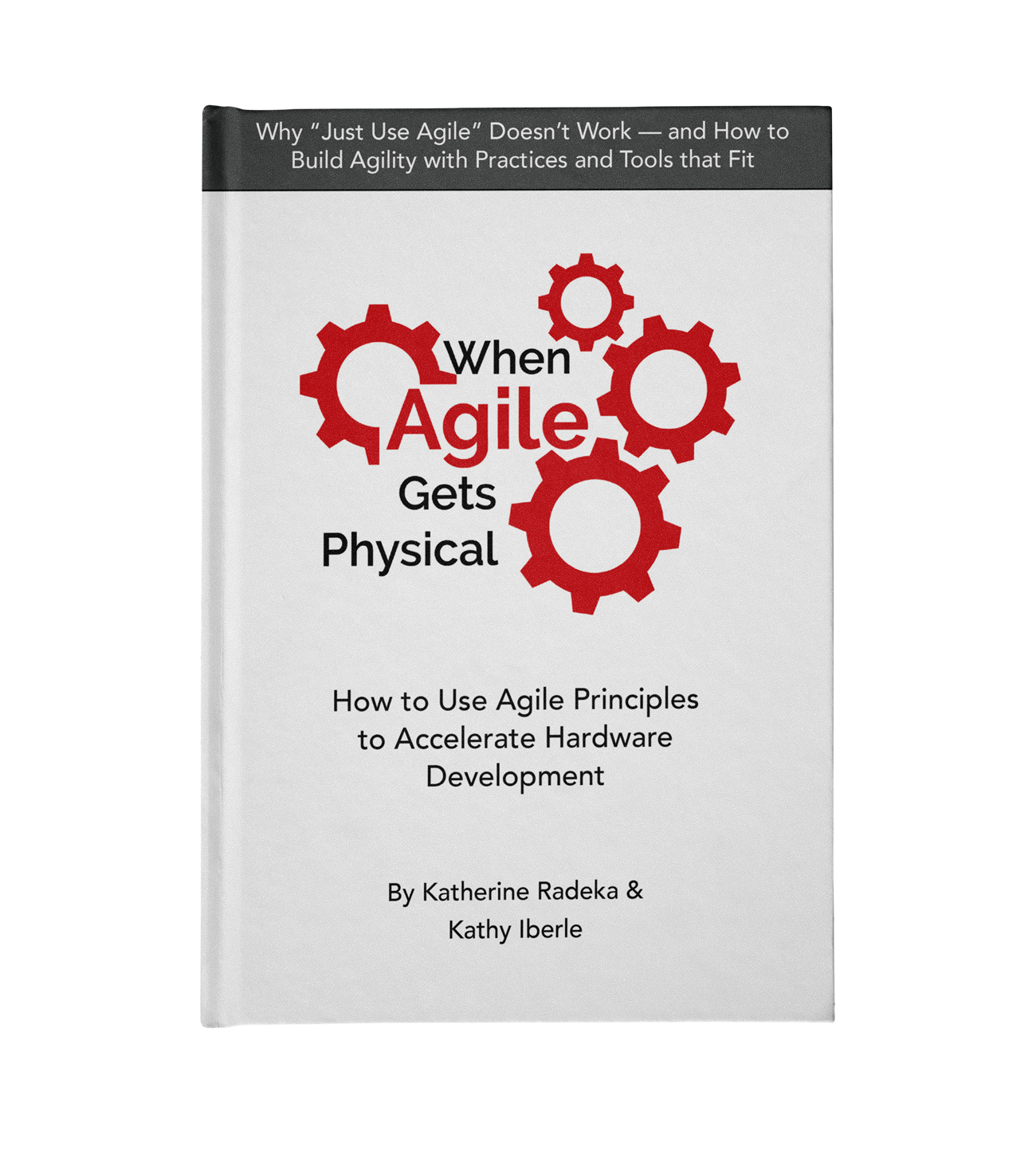
Learn How Agile Principles Can Help Your Physical Product Development Teams:
- Reduce time-to-market by 50% or more by using these proven methods to accelerate development.
- Keep your hardware and Agile software teams on the same page so that the product comes together in late development without force-fitting the wrong methods.
- Keep your engineers and scientists engaged by using practices and tools that fit their work instead of frustrated with ill-suited practices and rituals that waste their time.
The Problem with "Just Use Agile"
Over 20 years ago, the original Agile Software Development developers planted seeds that have helped software teams flourish: new IT technologies, the modern Internet and Artificial Intelligence tools were all built with Agile.
In the mid 2010s, companies began moving these proven practices into physical product development . . . only to find that they just didn't work. Teams burned up too much time with rituals and planning; they lost track of the overall project timeline and the real deadlines they needed to hit.
And even the teams that did OK didn't actually perform better. Their projects still had all the problems in late development that they had before, with less capacity to work through the problems.
How Reading This Book Helps Your Physical Product Development Teams
Agile: Fast, Flexible and Responsive
The word "agile" means "fast, flexible and responsive." It's the football player that gets the ball moving, and the gymnast who always lands on her feet. They are both quick, strong and flexible. But an agile football player has different skills than an agile gymnast.
And an agile mechanical engineer or industrial designer has a different skillset than an agile software developer or UX designer. They are both faster, more flexible, and more responsive than their peers, but they don't do the same things. The nature of the work is different, even if the need for agility is universal.
When Agile Gets Physical explains how physical product developers use the principles of Agile to become faster, more flexible and more responsive.
What’s Inside?
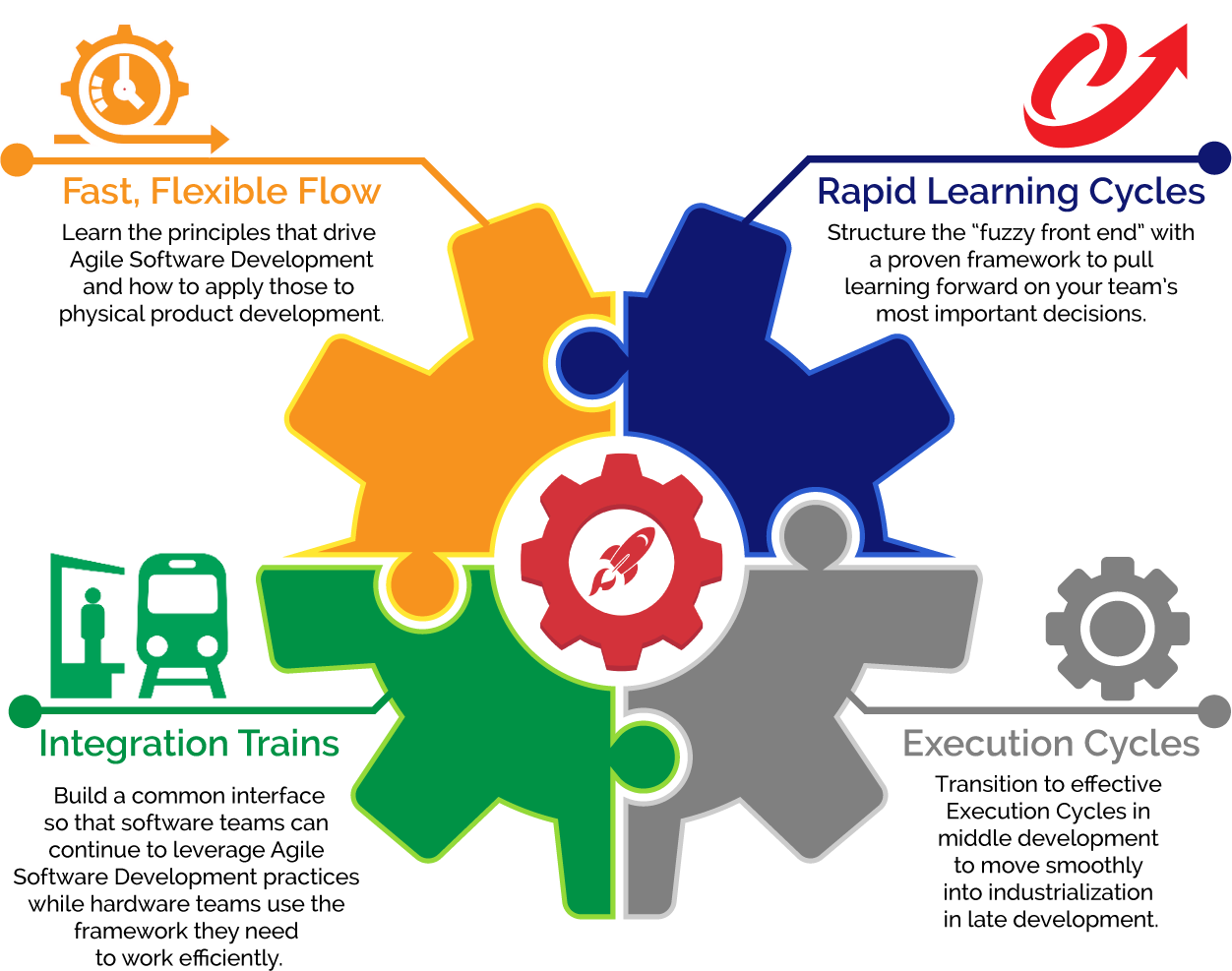
Universal Principles - Fit-for-Purpose Practices and Tools
The principles behind Agile Software Development are universal. They have their roots in the early days of the Industrial Revolution and came to fruition in the years after World War II, especially in places like Japan and Europe which had to rebuild quickly.
They've been applied on the production floor as "Lean Manufacturing" since the 1980s, in computer networks as "Queueing Theory" since the 1990s and in Agile Software Development since the 2000's.
The tools used by a Toyota production worker are not the same as the ones used to manage data on mobile phone networks. It's the principles, applied to the work-at-hand, that lead to practices and tools that achieve sustainable long-term results.
Why Did Katherine and Kathy Write This Book?
They saw the pain teams had experienced when they tried to use Agile Software Development practices for physical products.
ELIMINATE THESE PAIN POINTS FROM MISUSE OF AGILE
FOR PHYSICAL PRODUCT DEVELOPMENT
Since 2015, Katherine has been called out on a series of "Agile Rescue Missions" to help physical product teams that had gotten stuck after working with Agile Software Development experts who didn't understand the work of hardware development:
- Frustration when Agile Software practices don't work because backlogs blew up, daily standups got too repetitive and Sprint Events took too long to prepare and run.
- Lost productivity from ill-fitting tools when the teams were forced to write user stories, produce unnecessary prototypes for demos or spend too much time in meetings.
- Misguided advice from Agile Software Development coaches who "didn't get them" and interpreted their struggles as resistance instead of taking their pain seriously.
- Failure to solve the reasons why physical product development takes too long, costs too much and delivers disappointing results.
Get The Book Today!
What People Are Saying About When Agile Gets Physical

Andrew Flint
Product Development Director, IMPINJ
“"Efforts to synthesize common principles from the separate practices of Lean and Agile have been underway for over a decade. When Agile Gets Physical distills the right principles, derives methods to apply them, and in doing so represents a major milestone in defining the best practice of hardware product development."”
“I've known Kathy for many years via our joint love of quality software. This book is years in the making and based on lots of practical experience. It's going to be a good one to read. Well done, Kathy!”
Rick Anderson
Senior Director
Wind River
"Reading this was very much an affirmation of what I have believed in through much of my career in developing physical products. I learned the terminology that you have created to describe the RLC methodology."
John Vieth
Technology Research & Development Consulting
Vieth & Company
"I have not seen anything else that really defines how you
should approach the “fuzzy” front end, in a disciplined, time-boxed manner."
Tom Jacobson
Executive Leader
TSI Incorporated
Buy your copy today at any of these booksellers:



Author Spotlight

"When you can get your best ideas to market faster, you win, your team wins, your company wins, and your customers win.”
CO-AUTHOR
Katherine Radeka
Katherine is an internationally-recognized expert on innovation and product development who has helped hundreds of engineers and scientists to get their best ideas to market faster.
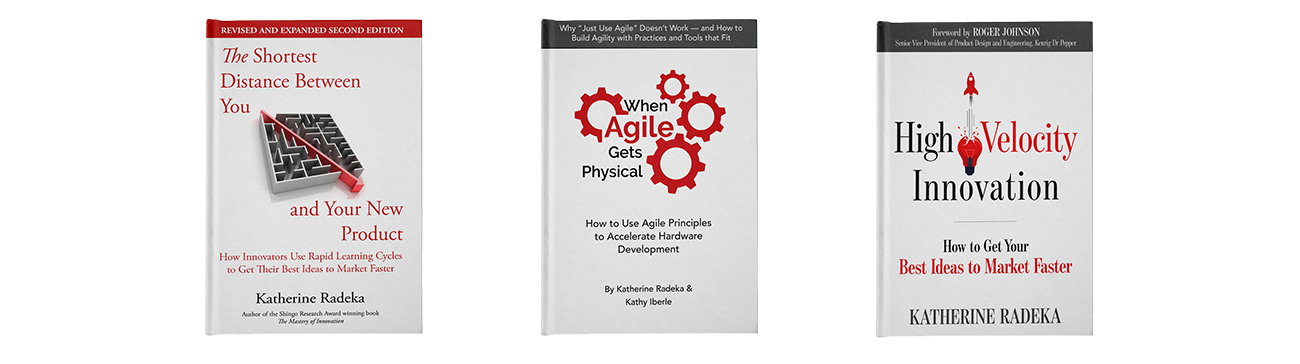
Author of the Shingo Research Award-winning book, The Mastery of Innovation and The Shortest Distance Between You and Your New Product: How to Get Your Best Ideas to Market Faster which is in its 2nd edition, and High Velocity Innovation: How to Get Your Best Ideas to Market Faster.
She has accelerated innovation on every continent except Antarctica and in industries from aerospace to alternative energy. Katherine lives in Camas, Washington.
CO-AUTHOR
Kathy
Iberle
When you know why agile works for software products, you can make hardware projects run faster with more flexibility.”

Kathy has a strong interest in effective problem-solving methods that drive data-driven decision making, and she played a key role in developing these aspects of the Rapid Learning Cycles framework.
Kathy’s background is in mixed hardware/software engineering with a focus on quality engineering. She has worked with a wide range of products – everything from printers to early web applications to cardiology and scientific instruments. In the course of her adventures in the high-tech world, she’s developed or improved many types of development processes for teams both large and small.
Kathy lives in Vancouver, Washington where she runs her own consulting business and enjoys hiking, camping, and snowshoeing in her spare time.
FIND ADDITIONAL RESOURCES ON OUR WEBSITE!
By creating a membership on our website, you gain access to the Shortest Distance Book Study Guide, free templates and our growing library of resources.
