

What are the most important decisions?
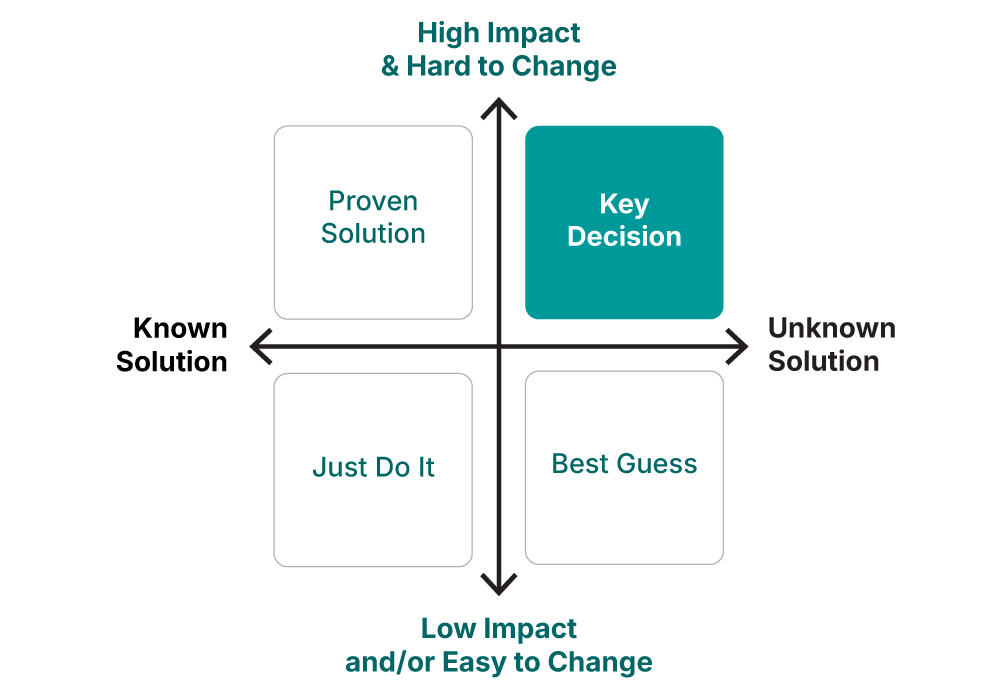
We focus squarely on the decisions that have the biggest impact, the greatest risk, and the largest knowledge gaps.
These are the decisions that often cause projects to miss deadlines, blow through their budgets, disappoint customers and stress out company leaders.
Not every decision needs this level of rigor.
Other decisions — decisions that are easy to change, low risk, or well-known — can be made in the way that people typically make decisions, with few consequences.
These Key Decisions deserve special focus and attention, because they represent the places where both the project and the company will gain a lot from being right — and lose a lot if the decisions go wrong.
What Types of Projects Use Rapid Learning Cycles?
Some types of projects have Key Decisions everywhere.
- Physical product development projects have many engineering decisions to make that will be hard to change later.
- Roll-outs of strategic initiatives across a large organization either fizzle out or get embedded deeply into the organization's ways of working. Either way, decisions have consequences.
- Advanced Research & Development where teams are under pressure to deliver new solutions for commercialization.
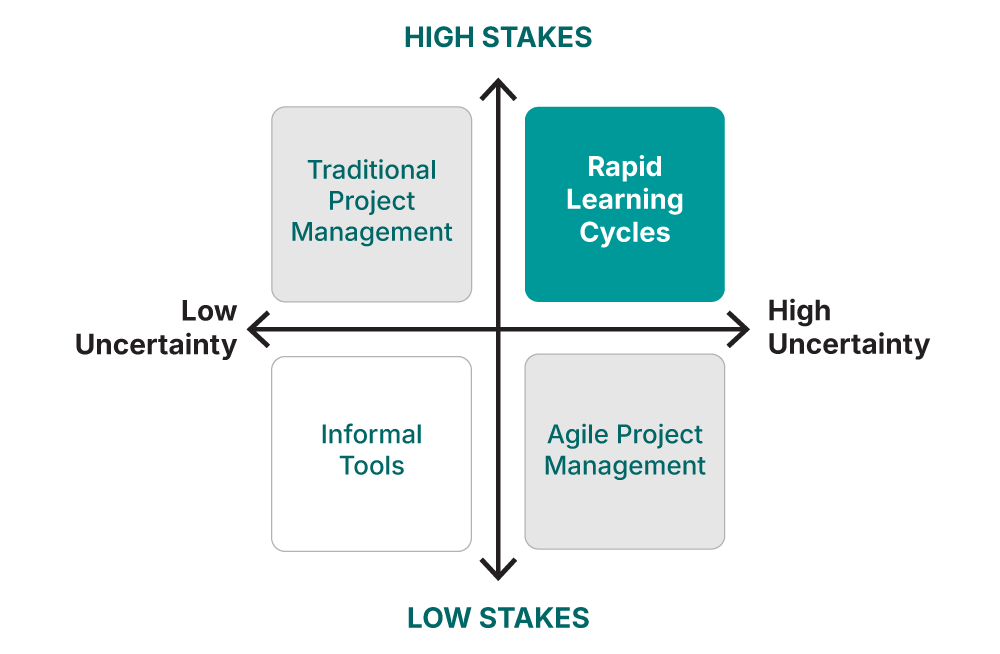
They all share the common characteristics of being high impact and high unknown, and are also usually large enough to justify the overhead of using the full framework.
Not every project needs the entire framework.
Some simple projects just have a small number of Key Decisions to make, but otherwise they can be managed well in a traditional project management framework.
Others are a better fit for Agile Software Development, except that there even there, architecture or technology choice decisions may be Key Decisions.
In these cases, teams can identify Key Decisions and make them at the right time with the right people and the best available knowledge without adoptiong the full RLC framework.
Agile That Works
Like Agile Software Development, the RLC framework delivers results by improving the flow of work through a project, from idea to launch. Unlike Agile Software Development, the RLC framework does not require force-fitting of practices and tools that were designed to work in software.
So the RLC framework is much easier for physical product development teams to learn, and continue to use on every project, without requiring ongoing support from a dedicated Agile Software Development coach.
PDP-Ready for Seamless Integration
The RLC framework integrates seamlessly with phase-gate / Stage-Gate® product development processes (PDPs) to make them work more effectively.
We transition the organization away from "waterfall" development that doesn't work very well anywhere without losing the governance, capacity and portfolio management from a well-designed PDP.

Standards-Compliant for Barrier-Free Adoption
Rapid Learning Cycles is compliant with ISO standards for innovation and product development practices, with just a few adjustments to your ISO process documentation.
It's adaptable to the regulatory requirements of the pharma, medical device, nuclear power, and other heavily-regulated industries.
The Key Difference Between Hardware & Software Development
Kathy Iberle, a Rapid Learning Cycles' Senior Advisor, describes why hardware teams need a specialized approach to get the results they want.
In their words...
"There are long lead time items that you have, like equipment decisions that have to get made very early on, and others, especially market decisions, that can wait.
One of the things that Rapid Learning Cycles helped in a very complex program like this is that in the beginning, there are so many decisions and so many unknowns, that everybody just wants to get them all answered.
But really what you need to be able to say is "some decisions you don't need to figure out until later. So what decision do I need to understand at the point that I may need to make that equipment purchase?"
By having the other decisions deferred, you actually have a lot of optionality while the market continues to evolve."

Celia Cheng,
SunPower
Preview the case for using the Rapid Learning Cycles methodology
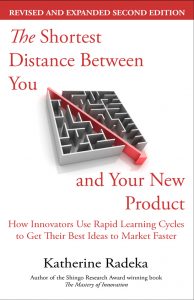
Download the introduction and first chapter of our CEO and Founder's book, The Shortest Distance Between You and Your New Product.
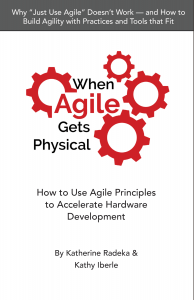
Eliminate the pain points from misuse of Agile for physical product development — insights from Katherine's latest book, When Agile Gets Physical, co-authored with Kathy Iberle.
